
Exploring the world of electromagnetism.
Visual data captures less than 0.005% of the electromagnetic spectrum. We build models that navigate the other 99.99%.

What we do
PHOS is a research and development lab building frontier hardware systems for generalized electromagnetic field design.
How molecules behave in a chemical reaction, how neurons fire in the brain, and how information flows on chip all come down to the electromagnetic (EM) forces governing our everyday interactions. Modeling how these forces behave is a case-specific process, requiring specialized hardware to collect real-world data and carefully designed simulation software built on complex numerical solvers. Modeling the behavior of such forces in a generalizable, physically verified environment without real-world deployment is impossible—until now.
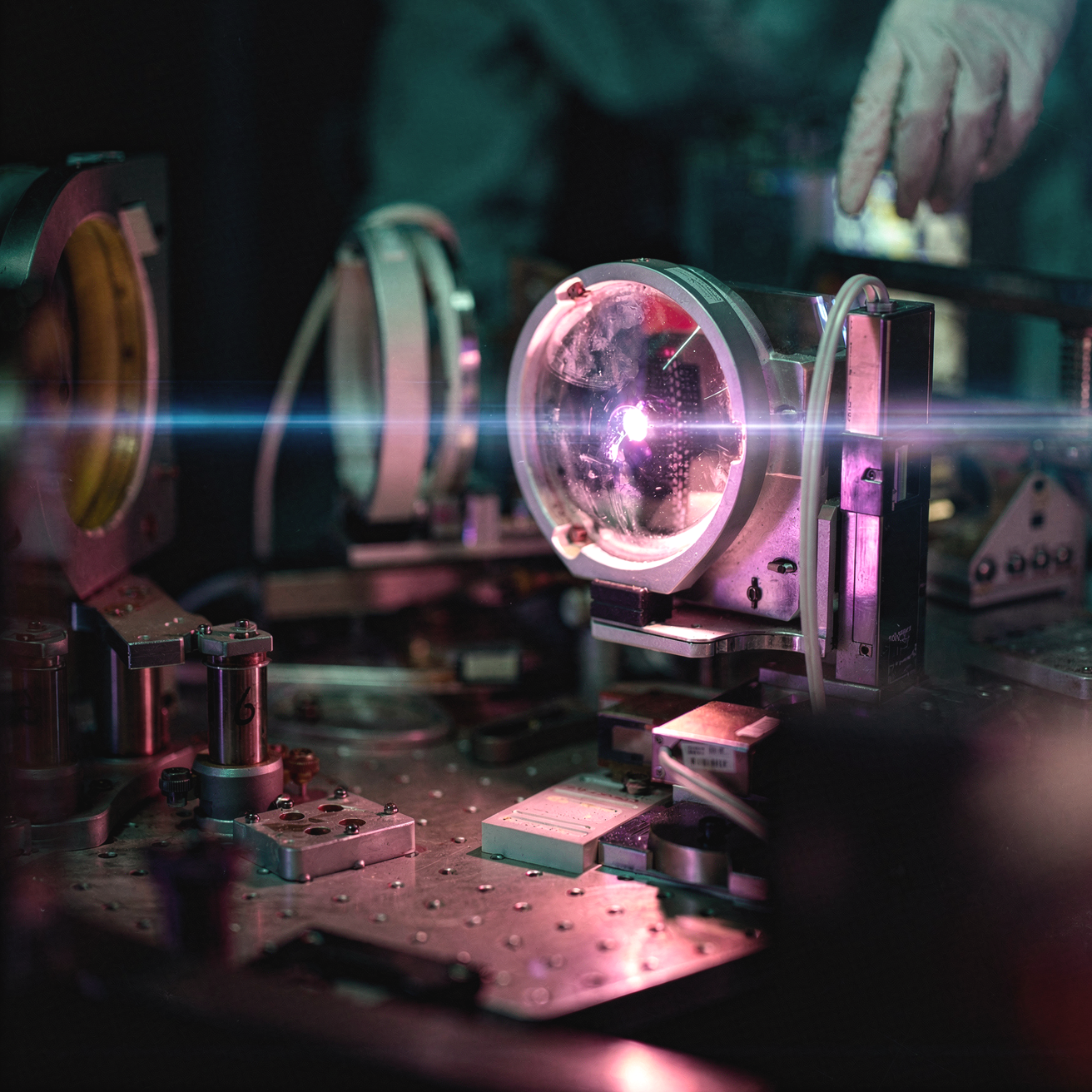
Our proprietary hardware uses electronically tunable plasma elements to simulate full-spectrum dynamic EM environments and arbitrary material compounds at nanosecond precision. Partnering with industry leaders in nuclear fusion, metamaterials development, edge computing, and more, we are building novel R&D pipelines to tackle open problems at the cutting edge of science.
Bridging the sim-to-real gap.
How physical systems behave in simulation does not accurately reflect their behavior in the real-world.
The sim-to-real gap in developing complex hardware systems can be attributed to two main failure modes. The first is that of compounding approximation errors when iterative numerical solves are used to approximate long trajectories of highly nonlinear systems sensitive to truncation errors, approximate boundary conditions, and sparse solves. The second is a result of the modeling choices that engineers must make in designing the simulation; mesh resolution, domain truncation, and which variables to take into account are all design decisions that propagate into a model’s understanding of the physical world. As a consequence, policies trained on such simulated environments learn the artifacts of the simulator rather than real-world physics, leading to degraded performance once deployed in hardware. Current solutions to this problem primarily rely on iterating through cycles of training in simulation, testing in hardware, collecting data, and improving the simulation using collected data. However, for domains where data collection and hardware tests are costly—such as nuclear fusion, large scale metamaterials design, and radar systems architecture—the problem remains intractable.
Enabling in-situ modeling of materials for autonomous inverse design.
Our current projects include fusion reactor optimization and metamaterials design. Currently, conventional hardware-in-the-loop RL pipelines still remain intractable for the development of robust nonlinear systems, such as those required for fusion and nanoelectronics, as end-to-end hardware tests accrue massive costs for mere seconds of viable test data while the inaccuracies that get propagated into the deployed controller from numerical simulations can result in hardware damages that cost up to billions to repair. In a world where time and capital are finite, results only see incremental improvements before projects run out of funding and companies take a pivot. Our approach effectively circumvents the bottlenecks of in-silico simulation and traditional RL pipelines by optimizing directly for the targeted EM objectives in-situ. In working with leading industry players across a breadth of domains, we are transforming how R&D is being done by creating agentic physical substrates that directly shape and interact with EM fields in the real world.
Shaping domains where it matters most.
Who We Are
Our founding team is made up of lead researchers from Stanford Plasma Physics Lab, Professor Mark Cappelli, director of Stanford Engineering Physics, and Dr. Alex Liu, who headed AI research at IBM. We bring together a team of industry experts in fusion with backgrounds spanning AI, physics, math, systems engineering, electrical engineering, and robotics.
Our mission at PHOS is not to make incremental progress on problems that humans can already solve—our mission is to develop the tools that enable humans to solve problems that no one in history has ever been able to solve.